Queen of the Corner—Doña Catita
My Tender MatadorThe relationship between the Queen of the Corner and Doña Catita is a long-running client-and-embroiderer arrangement that joins the Queen’s skilled labor to the social world of military privilege. Doña Catita values her as an artist and pays her well, while the Queen depends on elite commissions for her livelihood. Their professional connection is therefore both a source of income and a point of exposure: when a custom tablecloth for a September 11 dinner becomes late, the Queen must negotiate an excuse, a guarded entrance into the client’s world, and the political violence that the occasion represents.
A valued client and an artist’s work
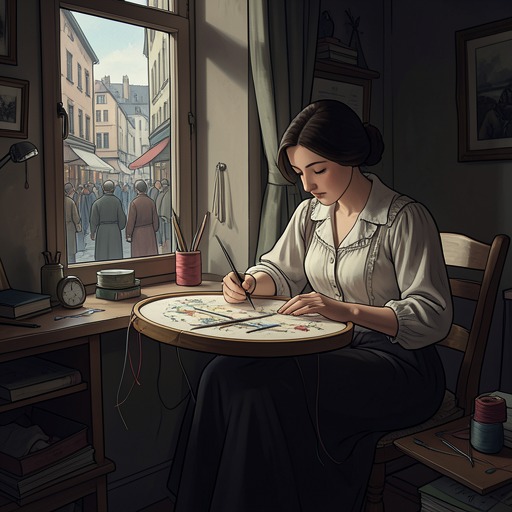
Doña Catita is introduced as the Queen’s oldest and most distinguished client, the wife of General Ortúzar. The Queen speaks of her as a real lady who treats her well, and stresses that she pays well and regards the Queen’s embroidery as artistic work. Their bond is not simply a transaction between strangers: Catita orders custom linens and has particular expectations for how they should look, while the Queen knows her tastes and takes pride in the quality of her own designs.
The commission at the center of their conflict is a tablecloth Catita has ordered for a dinner with her husband’s friends on September 11. The Queen says the cloth is finished, decorated with golden birds and little angels in iridescent thread. But Catita had also requested the Chilean coat of arms, with crossed swords, for the head of the table. The Queen has deliberately omitted it, judging that it would make the design look overdone and ordinary. She tries to persuade Catita to see the omission as an artistic decision rather than a failure to complete the order, even while acknowledging that Catita had made clear how important the emblem was to her.
The delay has a personal cause as well as an artistic one. The Queen had taken the cloth on a picnic with Carlos, who accidentally spilled chicken and soda on it. She needs to wash, bleach, starch, and iron it before delivery. Yet she is also reluctant to give up the patch of grass associated with the time she and Carlos spent together. Work, affection, and delay thus meet in one object: the cloth carries the marks of a private attachment into an order intended for a general’s household.
Excuses, class, and the approach to the mansion
When Doña Catita calls to ask about the overdue work, the Queen invents an elaborate account of having found a large extended family and being occupied with visits. The story reverses the truth she has previously told Catita about being an orphan, and the Queen recognizes that the explanation is fabricated. She does not want to tell her client that a man is responsible for the delay. Her improvised family reunion lets her protect a private attachment while keeping the commission alive, but it also shows the imbalance in the relationship: she must account for her time to a wealthy client who expects the work for a particular date.
The Queen promises to arrive around six and buys detergent and bleach before leaving the store. Her thoughts linger on Catita’s refined manners and appearance, even as she resents having to lie. The neighborhood’s older women gossip about the Queen’s relationship with Carlos and the men who visit her house; their speculation underscores how little privacy she has. The Queen hears them, pretends not to, and continues with the practical business of preparing the tablecloth.
On the delivery journey, she travels by bus into a markedly different district, where broad, clean streets and large houses contrast with the city she has left behind. At the gated street, a soldier stops her and questions the package. She explains that she is delivering it to Doña Catita, General Ortúzar’s wife, and that Catita is expecting her. The soldier calls to verify the claim, then opens the iron gate. The commission gives the Queen passage into a guarded enclave, but only after she identifies herself through the status of her employer.
The commission becomes a political encounter
At the mansion, Doña Catita is occupied with friends and has the Queen wait in the kitchen. The Queen recalls earlier deliveries, after long bus rides, when she was offered weak tea and crumbs rather than a proper meal. The grandeur of the house and the smallness of this hospitality sharpen the class difference between client and worker: Catita can commission elaborate linens, while the person who makes them is kept waiting in the service space.
The political meaning of the September 11 dinner becomes unavoidable when the Queen imagines the gathering of generals. In this vision, their celebration of the nation, the war, and the killing of Marxists contaminates the tablecloth: its embroidered birds and angels are overwhelmed by the blood and disorder of the imagined feast. The linen she has made with care becomes, in her mind, a record of national violence rather than a decorative centerpiece. This scene binds her personal labor to the public history surrounding the date, without suggesting that Doña Catita herself has seen or shared the Queen’s vision.
The sound of a grandfather clock brings the Queen back to the room. Overcome and nauseated, she gathers the tablecloth and leaves without completing the delivery. At the gate, the soldier notices that she looks pale and asks whether she is ill. She avoids explaining what has happened and walks away, anxious to get beyond his scrutiny. Her departure puts her standing with one of her best clients at risk, but it also marks a refusal to remain in the mansion and submit to the occasion on its own terms.
A strained arrangement and a claim to dignity
After leaving, the Queen first worries that Doña Catita will be furious and that she may lose the client. Then anger displaces that fear. She rejects the idea that Catita’s wealth and her husband’s rank make the Queen a servant without claims of her own, and recalls Carlos’s belief that all people are equal and deserve respect. The commission has exposed the limit of the Queen’s admiration for Catita’s refinement: good manners and fair payment do not erase the hierarchy that makes the Queen wait in a kitchen or feel compelled to invent excuses.
The relationship remains significant even after the failed delivery. Doña Catita’s order embodies the Queen’s achievement as an embroiderer: Rana taught her the basic stitches when she was poor and living on the street, and the Queen later developed the fine, meticulous work that won her commissions from affluent households. Catita’s custom order and high regard for her work belong to that professional ascent. At the same time, the Queen’s decision to leave the tablecloth at the mansion unfinished in practice—still in her possession, rather than delivered—shows that economic dependence does not wholly determine her conduct. In a relationship structured by patronage, the Queen asserts a measure of independence by choosing her dignity over the immediate security of pleasing a powerful client.
The connection also outlasts this confrontation in the Queen’s thoughts and the plot’s larger movement. As she prepares to leave, she entrusts La Rana with her belongings and unfinished work, including her radio, while saying that she cannot explain her departure and that it is a matter of life and death. The Queen’s exit shifts the focus away from her client network, but the episode has already shown what that network means: paid work can provide livelihood and recognition, while the households that purchase it remain entangled with the political order that makes the Queen’s position precarious.